 CalMind
Inside the Machine: How AI Food Recognition Works
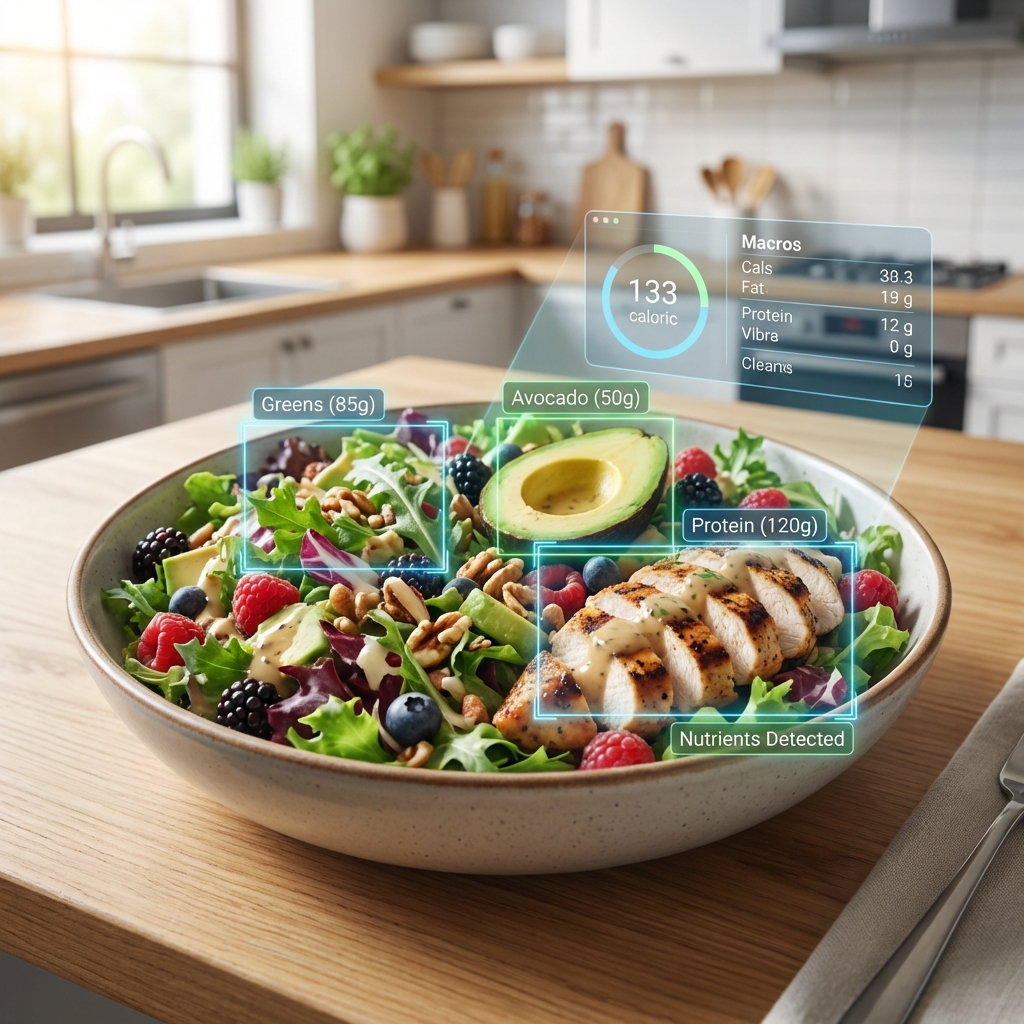
When you snap a picture of your lunch with CalMind, a complex series of deep learning algorithms springs into action. In less than a second, our food scanner algorithm performs tasks that would take a human nutrition expert several minutes, delivering industry-leading accuracy in AI calorie tracking.
Phase 1: Deep Learning Food Segmentation
First, the AI "looks" at the image using computer vision to distinguish food from non-food items (like the plate, fork, or table). It identifies individual components: the steak, the fries, and the salad are separated into distinct regions of interest for precise macro tracking.
Phase 2: Convolutional Classification
Next, the food recognition model identifies what each component is. Our database is trained on millions of labeled images covering global cuisines. It distinguishes between a "Cheeseburger" and a "Veggie Burger" by analyzing texture, color patterns, and context.
Phase 3: Volumetric Portion Estimation
This is the hardest part. Identifying "Rice" is easy; knowing if it's 100g or 300g is hard. CalMind uses computer vision depth estimation techniques to build a 3D model of the food relative to known reference objects to accurately calculate volume and portion sizes.
Continuous AI Learning
The system is designed to learn. Every time a user confirms an entry, the neural network gets smarter for the next user. This collective intelligence makes CalMind the most rapidly evolving food recognition app technology in the world.
Frequently Asked Technical Questions
How does an AI food scanner calculate calories?
An AI food scanner calculates calories by first using computer vision to identify the food items on the plate. It then uses depth estimation to calculate volumetric portion sizes and cross-references this data with an extensive nutritional database to deliver an accurate calorie count.
Can computer vision measure food volume?
Yes. Advanced AI calorie counters like CalMind use 3D depth-mapping techniques to estimate the portion size or volume of the food relative to known reference objects, significantly improving the accuracy of macro tracking.
Why is deep learning used for food recognition?
Deep learning algorithms, especially Convolutional Neural Networks (CNNs), are exceptionally good at identifying complex patterns, textures, and colors in different cuisines, making them the most reliable technology for accurate food logging.