 CalMind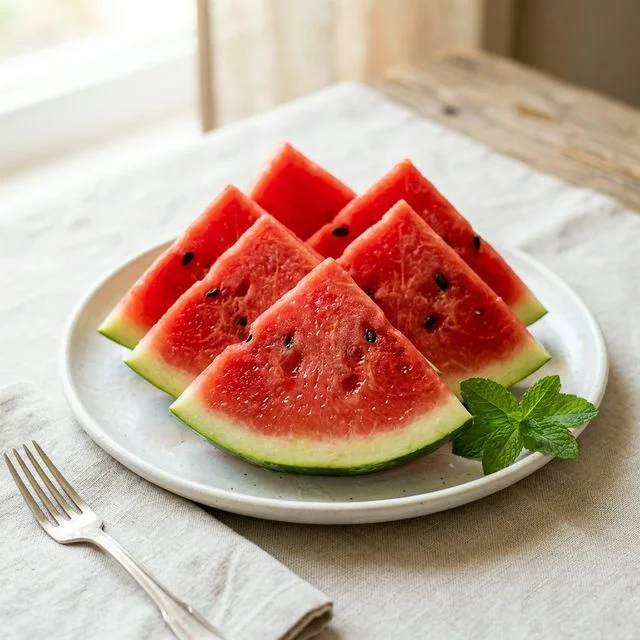
Watermelon calories per 100g: 30 kcal
Nutrition Facts per 100g (Raw)
Watermelon: Volume & Calories Comparison
*With a 92% hydration volume, watermelon provides unprecedented physical satiety relative to its calories.
Watermelon nutrition: slices, wedges, sugar, hydration, and portions
Watermelon has about 30 calories per 100g, and a cup of diced watermelon is roughly 46 calories. It is low in calorie density because it is mostly water.
Large slices can still vary a lot by size, so tracking the portion matters. Use the CalMind photo calorie tracker to scan a wedge or bowl and estimate watermelon calories without weighing every piece.
The Lycopene and Micronutrient Payload Architecture
While frequently and culturally unfairly dismissed by strict, old-school dietitians as merely purely sweet flavored water lacking true nutritional density, modern clinical watermelon analysis quietly yet reliably delivers a highly respectful, scientifically robust physical dose of crucial human micronutrients. A typical standard daily serving forcefully and consistently provides medically notable dietary amounts of vital immune-boosting Vitamin C (delivering roughly 14% of the standard FDA daily physical value) alongside a highly respectable, bioavailable dose of clinical Vitamin A (averaging 11% daily value for sustained ocular health and robust cellular skin regeneration).
However, mathematically and biologically far more importantly, watermelon is widely and globally celebrated in serious academic physical nutrition circles as one of the absolute most potent, chemically dense, natural raw sources of deep dietary lycopene available in the entire human food supply chain. This remarkably potent, vibrant red physical antioxidant is chemically and mainly linked often by large epidemiological studies to vastly improved human heart health diagnostics and deep, long-term complex cellular DNA protection. Astoundingly, standard raw pink watermelon mathematically and chemically significantly outperforms raw commercial red tomatoes in mainly equivalent physical gram-for-gram body Lycopene measurements, effectively making it a clinically superior dietary antioxidant delivery vehicle.
The Elite Citrulline Athletic Advantage Mechanism
Even strict, institutional competitive bodybuilders tracking their absolute physical daily macros down to the structural decimal point can usually and functionally easily find safe overall room for a large, physically large raw watermelon wedge. A often enormous single wedge (typically significantly weighing around a colossal 286g) safely and chemically contains only about 86 total physical calories, leaving total daily caloric budgets deeply and perfectly intact. Although highly structured energy endurance athletes sometimes initially and culturally violently worry about the body insulin impact of raw, rapid fruit sugars, the remarkably unbelievably high liquid water content chemically guarantees that the actual body overall glycemic physical load of raw watermelon functionally and mainly remains practically completely metabolically harmless to healthy human adults.
In stark, direct scientific fact, many elite international professional long-distance endurance athletes purposefully, violently, and deliberately consume large physical quantities of raw pure watermelon juice specifically and precisely for its exceptionally high, naturally organically occurring chemical levels of active dietary L-citrulline. This highly unique, deeply powerful body alpha-amino acid is scientifically and widely fundamentally believed by elite clinical sports dietary researchers to rapidly, naturally, and chemically strongly enhance deep vascular nitric oxide (NO) vascular production. This resulting meaningful overall vasodilation strongly often physically accelerates deep structural muscle recovery, strongly flushes severe lactic acid buildup, and significantly improves sustained oxygen delivery during incredibly grueling physical outdoor summer athletic competition and severe hypertrophic weight training.
🔥 How to burn 46 Calories (1 cup strongly diced)?
- Run (6 mph steady rhythm): 5 minutes
- Cycle (Moderate vigorous resistance): 7 minutes
- Walk (3.5 mph brisk active pace): 12 minutes
- Rowing (High intensity output): 4 minutes
Note: Caloric expenditure varies based on age, gender, and current body weight.
Frequently Asked Questions
Is watermelon good for weight loss?
Yes. Watermelon is low in calorie density because it is mostly water, but large portions still count.
Does watermelon have too much sugar?
No for most people. A cup has less sugar than many fruits, and the high water content keeps calorie density low.
Why do athletes eat watermelon?
Watermelon provides fluid, carbs, and citrulline. It can be a useful light snack around training.
Does watermelon contain lycopene?
Yes. Red watermelon contains lycopene, though tomatoes are still a common lycopene source.