 CalMind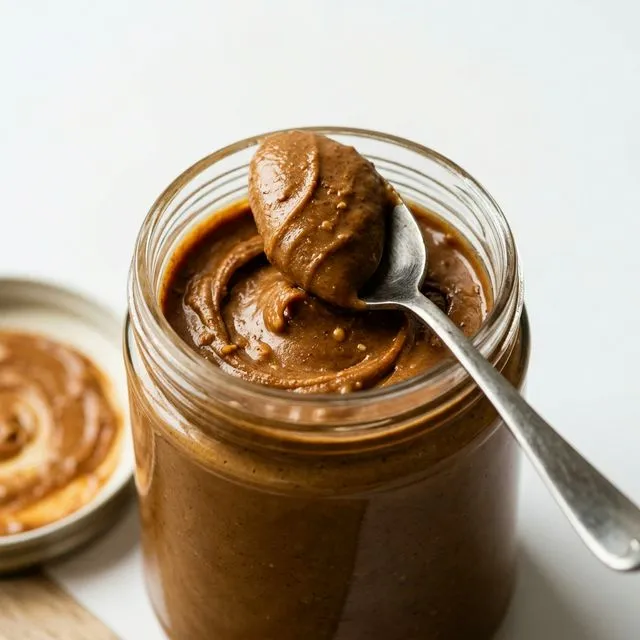
Peanut butter calories per 100g: 588 kcal
Nutrition facts per 100g and per 2 tablespoons (32g)
Peanut Butter Variations: Nutrition Comparison (Per 32g / 2 Tbsp)
Peanut butter nutrition: tablespoons, protein, fat, sugar, and portions
Peanut butter is calorie-dense: about 588 calories per 100g, or roughly 188 calories for a 2-tablespoon serving. Most calories come from fat, with a useful amount of plant protein.
It can support muscle gain or higher-calorie meal plans, but it is easy to overeat during weight loss. Use the CalMind photo calorie tracker to scan toast, oatmeal, smoothies, or spooned servings so the actual amount is logged.
The Muscle-Building Protein Profile
Beyond its high lipid-driven energy payload, peanut butter serves as a highly efficient, entirely plant-based body protein delivery system. Yielding approximately 25 grams of functional dietary protein per 100 grams (matching or exceeding many foundational animal meats by raw dry weight), it consistently provides critical structural amino acids necessary for continuous muscle tissue synthesis and rapid post-workout body repair. A mainly measured standard two-tablespoon serving (roughly 32 grams) efficiently provides 7 solid grams of dietary protein directly alongside 188 dense calories.
It is fundamentally critical to acknowledge, however, that peanut protein physically remains scientifically classified as a biologically "incomplete" protein source. Specifically, peanuts natively lack sufficient concentrations of the essential amino acid methionine. To successfully artificially engineer a complete, fully functional body amino acid profile capable of maximizing total overall muscle protein synthesis, nutritional experts universally recommend actively pairing peanut butter directly alongside complementary cereal grains—such as spreading it generously over high-quality toasted whole wheat bread or intensely mixing it directly into hot morning oatmeal bowls.
Navigating Commercial Additives and Ingredients
The single greatest hidden danger inherent specifically to modern peanut butter consumption rarely originates directly from the humble native legume itself; instead, the meaningful dietary damage consistently stems from artificial commercial manufacturing interventions. Major international supermarket brands routinely compromise the raw nutritional integrity of their bulk products by artificially injecting large volumes of highly refined crystalline white sugars and chemically stabilized partially hydrogenated vegetable oils. These highly unnatural, purely profit-driven industrial additives shatter the natural body lipid balance, mathematically converting a notably healthy whole-food paste into a highly processed, significantly inflammatory commercial dessert.
To safely secure the total maximum functional health benefits, disciplined consumers must exclusively purchase "natural" peanut butter variants featuring exactly one single base ingredient explicitly listed dynamically on the rear nutritional label: dry roasted peanuts (with optionally a minor trace amount of coarse sea salt). While these premium natural variants physically require manual mechanical stirring due to natural lipid separation, this minor physical inconvenience absolutely definitively guarantees a higher-quality, structurally pure macronutrient profile totally free from hidden engineered industrial trans fats. Since a single scoop can significantly shift your daily intake, rely absolutely on the CalMind photo calorie tracker. A quick scan of your spoon allows our AI to precisely gauge the volume, locking in those dense fat and protein macros before you even take a bite.
🔥 How to burn 188 Calories (2 tbsp)?
- Run: 19 minutes
- Cycle: 25 minutes
- Walk: 50 minutes
Frequently Asked Questions
How many calories are in peanut butter per 100g?
Peanut butter has about 588 calories per 100g.
How many calories are in 2 tablespoons of peanut butter?
Two tablespoons (about 32g) are typically around 180-190 calories.
Is peanut butter good for weight loss?
It can fit fat-loss plans if serving size is measured carefully.
Natural vs regular peanut butter: is there a calorie difference?
Calories are often similar; the bigger difference is added sugar, oil, and sodium.