
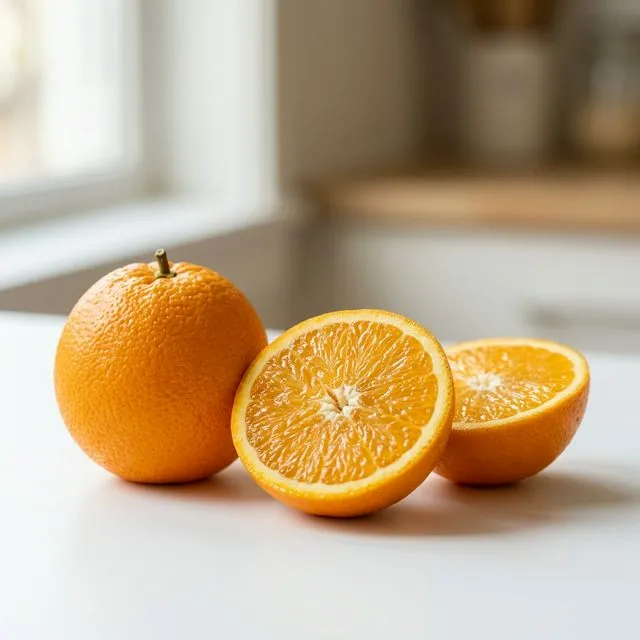
Orange calories per 100g: 47 kcal
Nutrition Facts per 100g (Raw)
Orange Varieties: Nutrition Comparison (Raw, Per 100g)
Orange nutrition: whole fruit, juice, vitamin C, fiber, and portions
A raw orange has about 47 calories per 100g. A medium orange is usually around 62 calories, with roughly 12g carbs, 0.9g protein, and almost no fat.
Whole oranges are usually better than orange juice for weight management because the fiber slows sugar absorption and helps fullness. Skip guessing whether you have a medium or large orange: scan it with the CalMind photo calorie tracker and log the portion in seconds.
The Ascorbic Acid and Hesperidin Matrix
The most globally celebrated, repeatedly clinically validated nutritional characteristic of the orange is undoubtedly its massive, fundamentally overwhelming concentration of active Ascorbic Acid (Vitamin C). A single standard medium orange quickly provides a staggering 89% of the strict total recommended daily physiological intake value for this highly critical, structurally essential water-soluble vitamin. As a vastly powerful native systemic cellular antioxidant, this raw organic Vitamin C strongly actively physically scavenges dangerous deteriorating free radicals, notably accelerates the natural external biological wound healing process, and is strictly metabolically required for the foundational internal synthesis of resilient tight human skin collagen and rigid connective skeletal tissue.
Beyond isolated ascorbic acid, oranges uniquely operate as a massive organic structural bio-delivery system for incredibly potent specific natural citrus flavonoids—most notably, the deeply researched compound known clinically as Hesperidin. Found heavily concentrated specifically within the soft inner spongy white vascular pith (the albedo) deeply surrounding the sweet juicy internal fleshy segments, hesperidin has been consistently rigorously scientifically proven to fundamentally improve total long-term cardiovascular health. It successfully achieves this explicitly by measurably safely lowering systemic diastolic blood vessel pressure while simultaneously robustly reducing overall bodily systemic inflammatory markers.
The Critical Dietary Difference: Whole Fruit vs. Juice
A frequent nutritional error involves confusing the metabolic benefits of consuming solid whole oranges with the consumption of heavily concentrated commercial orange juice. While fresh squeezed juice retains the core vitamin profile, the mechanical extraction process completely removes the crucial intact whole-fruit soluble dietary fiber.
Within a solid medium orange, approximately 2.4 to 3 grams of woven fibrous pectin naturally delays gastric sugar absorption within the human intestinal tract. This fibrous pectin deliberately prevents sudden reactive blood sugar spikes, allowing the body to process the natural fructose load safely and efficiently. By contrast, a standard 8-ounce glass of liquid juice actively bypasses these physical digestive barriers, flooding the pancreas with an immediate, massive glucose load that often triggers subsequent energy crashes and aggressive fat storage.
Orange Format Caloric Alert: Glycemic Index Dangers
How destroying the physical fiber matrix changes an orange from a health food to a metabolic burden.
🔥 How to burn 62 Calories (1 medium)?
- Run: 6 minutes
- Cycle: 9 minutes
- Walk: 17 minutes
Frequently Asked Questions
How many calories in a glass of orange juice?
An 8 oz glass of orange juice has about 112 calories — almost double a whole orange. Whole oranges are better for weight management because the fiber slows sugar absorption and increases satiety.
Are oranges good for weight loss?
Yes. At 47 calories per 100g with high water and fiber content, oranges are filling relative to their calorie count. They satisfy sweet cravings naturally without added sugars.
Does eating oranges at night cause fat gain?
No. Timing does not cause fat gain; total daily calories do. A medium orange is a low-calorie snack.
Can you eat the white pith inside an orange?
Yes. The pith contains fiber and flavonoids. It tastes bitter, but it is safe for most people.
CalMind