
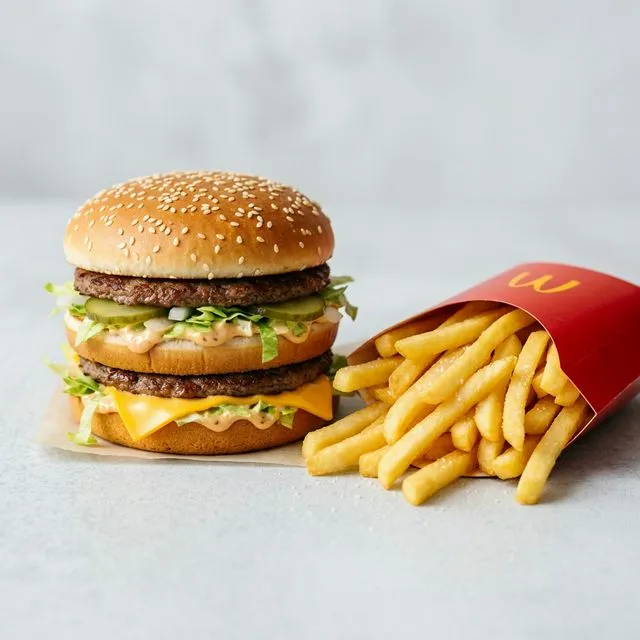
Calories in McDonald's

McDonald's calories and nutrition calculator

Nutrition Facts per Big Mac

563Calories
26gProtein
44gCarbs
33gFat

McDonald's Classics: Nutrition Comparison

Menu Item Calories Protein Carbs Fat
Big Mac (Reference) 563 26g 44g 33g
Egg McMuffin 310 17g 30g 13g
Filet-O-Fish 380 15g 39g 18g
6-piece McNuggets 250 15g 15g 15g

McDonald's Nutritional Profile: Track Macros With AI

As the undisputed global titan of modern fast food, McDonald's notably shapes international dietary habits. While the iconic brand is historically associated with rapid-digesting carbohydrates and massive caloric surpluses, an extremely careful, strategic analysis of their core menu reveals that strictly disciplined nutritional navigation is entirely possible. By using a photo calorie tracker like CalMind, you can easily snap a picture of your McDonald's tray and instantly log your meal. Understanding the exact macro breakdown behind signature items helps fitness-minded individuals successfully integrate specific McDonald's meals into their diets without derailing their progress.

The legendary Big Mac stands as the absolute foundational nutritional benchmark for the entire franchise. A standard, unmodified Big Mac officially yields roughly 563 total calories, delivering a highly respectable 26 grams of muscle-building protein specifically derived from its dual beef patties and distinctly processed cheese slice. However, it critically pairs this protein with 44 grams of dense carbohydrates (driven by the unique triple-bun architecture) and 33 grams of total systemic fat (largely stemming from the signature heavily emulsified "Mac Sauce"). While a 563-calorie sandwich can mathematically fit perfectly into a standard daily caloric budget, the true dietary danger consistently arises not from the burger itself, but from the strongly dense, highly caloric supplementary side items traditionally bundled with it.

The Compounding Danger of the "Extra Value Meal"

The most negative common dietary trap encountered at McDonald's severely revolves around the classic combination meal structure. Purchasing a standard core sandwich is mathematically manageable; however, casually upgrading to a standard "Extra Value Meal" introduces an immediate, massive influx of perfectly hidden empty liquid and fat calories. A standard medium order of World Famous Fries instantly injects an additional 320 heavily dense calories and 15 grams of pure highly refined cooking fat. Pairing this with a standard medium non-diet fountain soda subsequently violently adds another 200 entirely empty, immediately massive rapid-digesting liquid sugar calories.

The Extra Value Meal Explosion

How bundling practically ruins a perfectly decent macro profile.

Burger Only
563 kcal
Big Mac on its own. 26g protein, manageable.
Medium Fries
+ 320 kcal
Zero protein, entirely fat and carbs.
Medium Coke
+ 200 kcal
55g of pure liquid sugar. No satiety at all.

Consequently, a single seemingly innocuous medium Big Mac meal instantly skyrockets to a minimum of 1,080 total calories, fundamentally blowing out the standard macro budget for an average adult. To intelligently counteract this massive rapid accumulation, structural dieters absolutely must ruthlessly execute strict defensive substitutions. Prioritizing zero-calorie diet sodas, unsweetened iced black water teas, or simply requesting a basic black coffee instantly heavily eliminates hundreds of useless liquid calories, completely rescuing the meal's underlying biological utility.

Optimizing the Breakfast Menu

Interestingly, the McDonald's morning breakfast menu actively contains some of the absolute leanest, most mathematically optimal fast-food macro ratios currently available in the commercial landscape. The classic Egg McMuffin represents a genuinely exceptional, clinically approved dietary choice. By utilizing a real cracked Grade A egg paired with lean Canadian bacon and a standard slice of processed cheese on a lightly toasted English muffin, the sandwich delivers a tightly incredibly controlled 310 total calories alongside a solid 17 grams of highly bio-available immediate morning protein. This heavily sharply strongly cleanly contrasts with the significantly denser Sausage McGriddles or heavy folded-egg Biscuit sandwiches, which quickly exceed 500 calories predominantly driven by heavy saturated fat and syrupy refined sugar.

🔥 How to burn 563 Calories?

  • Run: 56 minutes
  • Cycle: 80 minutes
  • Walk: 150 minutes

Frequently Asked Questions

Are McNuggets high protein?

Decent. A 6-piece nugget pack has 250 calories and 15g protein. It's one of the better macro ratios on the menu.

Is the Filet-O-Fish healthy?

Not particularly. It has 380 calories but is low in protein (15g) compared to beef burgers, largely due to the breading and tartar sauce.

How many calories are in a McDonald's Egg McMuffin?

An Egg McMuffin contains 310 calories, 17g of protein, and 13g of fat, making it one of the healthiest breakfast options on the menu.

Are McDonald's fries vegan?

In the United States, McDonald's fries are not vegan or vegetarian, as they are prepared with a natural beef flavoring that contains milk and wheat derivatives.

Track this food

Snap a photo. See calories & macros.

Start with one photo. CalMind instantly shows calories and macros—so staying consistent feels easy.

Track this food