 CalMind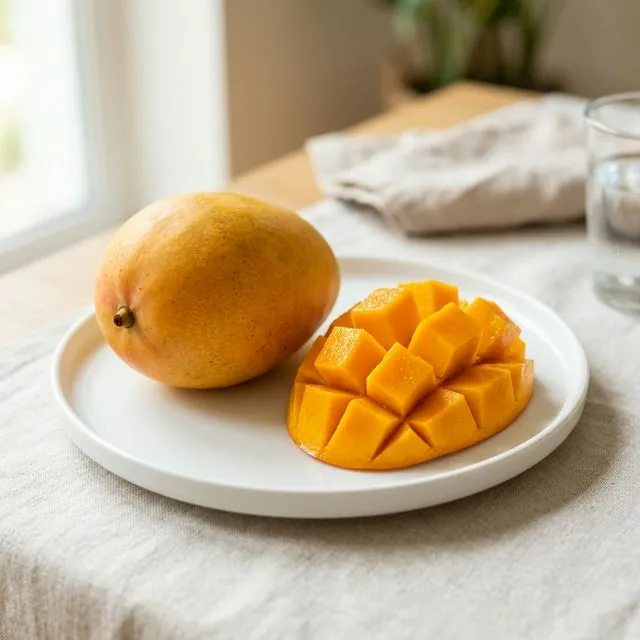
Mango calories per 100g: 60 kcal
Nutrition Facts per 100g (Raw)
Mango Variations: Nutrition Comparison (Per 100g)
Mango nutrition: fresh mango, dried mango, juice, and portions
Fresh mango has about 60 calories per 100g. A chopped cup is roughly 99 calories, while a whole average mango can reach about 202 calories depending on size.
Mango can fit a weight-loss plan, but portion size matters because dried mango and mango juice concentrate sugar and calories. Scan your bowl with the CalMind photo calorie tracker to estimate chopped mango portions without measuring cups.
The Strategic Impact of Vitamin C and Vitamin A
The true biological value of the mango lies directly in its massive concentration of core essential vitamins. A single diced cup strongly supplies an notable 76% of the total recommended daily allowance for Vitamin C. This critical water-soluble vitamin fundamentally drives total-body immune optimization, powerfully stimulates natural collagen synthesis for skin elasticity, and operates as a potent systemic antioxidant neutralizing cellular free radicals generated by intense physical stressors.
Simultaneously, the deeply rich, bright orange flesh visually signals a massive presence of beta-carotene, which the human body efficiently converts directly into active Vitamin A. Supplying nearly 25% of the daily required Vitamin A baseline per cup, consistent mango consumption directly supports deep ocular health, actively maintains cellular structural integrity, and critically bolsters long-term immune defense protocols. For athletes experiencing heavy oxidative stress from aggressive training cycles, these dual antioxidant pathways offer massive, highly measurable recovery benefits.
Digestive Enzymes and Glycemic Control
Despite its rich, almost dessert-like sweetness, mango actually maintains a deeply respectable, highly moderate Glycemic Index (GI) score of roughly 51. This mathematical stability is primarily physiologically driven by its robust 2.6 grams of soluble digestive fiber per cup, which successfully blunts the speed at which the fruit's natural fructose enters the raw bloodstream, radically preventing massive insulin spikes. Furthermore, mango uniquely natively contains a powerful specific group of digestive enzymes universally known as amylases. These specialized active enzymes physically assist the gut microbiome in systematically breaking down complex dietary carbohydrates into rapidly usable simple sugars, effectively streamlining the entire comprehensive digestive process and systematically reducing post-meal gastric bloating.
🔥 How to burn 99 Calories (1 cup sliced)?
- Run: 10 minutes
- Cycle: 14 minutes
- Walk: 27 minutes
Frequently Asked Questions
Is mango good for weight loss?
Mango can fit into a weight loss diet when eaten in moderation. One cup (99 calories) is satisfying and nutrient-dense. Just watch portion sizes since whole mangoes can be calorie-dense at 202 calories each.
How many calories in dried mango?
Dried mango has about 319 calories per 100g — more than 5x the fresh version. The dehydration concentrates sugars and calories. Always prefer fresh mango for weight management.
Can eating a whole mango daily cause fat gain?
A mango does not cause fat gain by itself, but a whole fruit can add 200+ calories. Fit it into your daily target.
Fresh mango vs mango nectar: which has more calories?
Mango nectar is usually easier to overdrink because it removes fiber and may add sugar. Whole mango is more filling per calorie.