 CalMind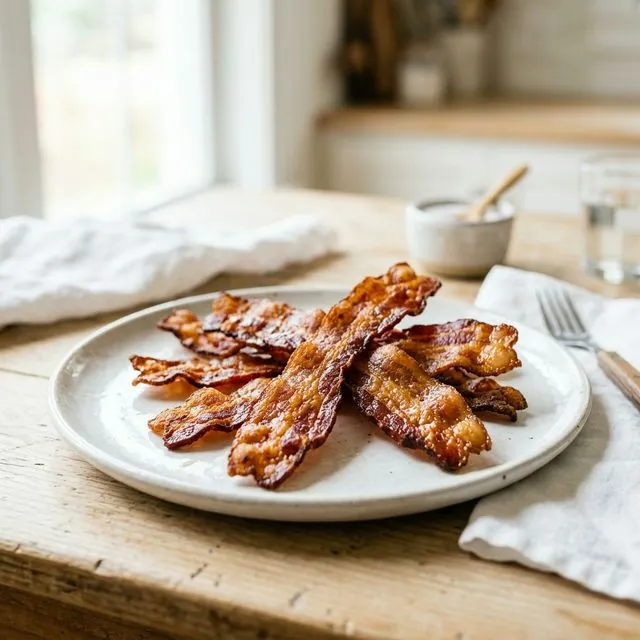
Bacon calories per 100g: 541 kcal
Nutrition Facts per 100g (Pan-Fried, Crispy)
Bacon Nutritional Comparison
Bacon nutrition: calories, strips, turkey bacon, and keto
Bacon is often simultaneously praised for its incredible, savory flavor profile and scrutinized for its high calorie and fat content. To truly understand its place in a healthy diet, you must look closely at how it is sourced, prepared, and weighed. A standard 100-gram serving of pan-fried, crispy pork bacon contains a massive 541 calories. However, context is absolutely critical here: nobody eats 100 grams of cooked bacon in a single sitting. A typical serving consisting of two standard strips of crispy bacon weighs roughly 16 to 20 grams, yielding a much more manageable 86 to 108 calories. When viewed through the lens of proper serving sizes, bacon can easily fit into almost any macronutrient tracking plan. The CalMind photo calorie tracker can instantly scan your plate and accurately log the calories in your cooked bacon, eliminating the guesswork.
Understanding Maconutrients in Bacon
The macronutrient profile of cooked bacon is heavily skewed toward fats and proteins, making it naturally essentially zero-carb (containing only about 1.4g of carbohydrates per 100g, mostly from trace sugars used in the curing process). A 100-gram serving provides an notable 37 grams of high-quality animal protein. This means that two strips of bacon deliver about 7 to 8 grams of complete protein, which effectively contributes to your daily requirements for muscle protein synthesis.
Regarding fat, a 100g serving of cooked bacon contains approximately 42 grams of total fat. It's vital to note that not all of this is saturated fat. About 50% of the fat in bacon is actually monounsaturated fat, primarily consisting of oleic acid—the exact same heart-healthy fatty acid found in olive oil. Another 40% is saturated fat, and the remaining 10% is polyunsaturated fat. The saturated fat content does mean bacon should be consumed mindfully, especially by individuals specifically monitoring their LDL cholesterol levels, but the prominent presence of oleic acid often surprises health-conscious consumers.
Essential Micronutrients and Vitamins
Beyond being a source of dense energy, pork bacon is surprisingly rich in several essential micronutrients. Because pigs are exceptional at converting what they eat into highly bioavailable vitamins in their muscle tissue, bacon provides a robust dose of several B-vitamins. A standard serving gives you significant amounts of Vitamin B12, B1 (Thiamin), B2 (Riboflavin), B3 (Niacin), and B6. These B-complex vitamins are critical coenzymes required for cellular energy production, brain function, and maintaining a healthy central nervous system.
Furthermore, bacon contains notable amounts of vital minerals. It is particularly rich in Selenium (providing over 45% of your Daily Value per 100g) and Phosphorus. Selenium is a powerful antioxidant mineral that plays a fundamental role in preserving optimal thyroid gland function and regulating your metabolic rate. Additionally, bacon provides small but highly bioavailable amounts of dietary iron, zinc, and magnesium.
The Sodium Equation and Curing Agents
The primary nutritional concern when consuming bacon is not necessarily the fat or calories, but the sodium content. Because bacon is a cured meat, salt is used strongly in its preparation to preserve the flesh, prevent bacterial growth, and enhance flavor. A 100-gram serving of cooked bacon can contain upwards of 1,717mg of sodium. Therefore, eating just two slices can contribute over 300mg of sodium to your daily intake. For individuals battling hypertension or salt-sensitive blood pressure, this must be carefully strictly monitored and factored into their daily allotment.
Additionally, conventional bacon is cured utilizing synthetic sodium nitrates or nitrites. When heated to high temperatures during pan-frying, these nitrites can form nitrosamines, which are classified as potential carcinogens. To mitigate this risk, many nutritionists recommend purchasing "uncured" bacon. While "uncured" bacon utilizes natural celery powder (which contains naturally occurring nitrates) instead of synthetic chemicals, it remains a heavily processed food and should be treated as an occasional flavor enhancer rather than a daily protein staple.
🔥 How to burn 108 Calories (2 strips of bacon)?
- Run (6 mph pace): 10 minutes
- Cycle (Moderate effort): 14 minutes
- Walk (3.5 mph brisk pace): 28 minutes
- Stair climbing: 12 minutes
Note: Caloric expenditure varies based on age, gender, and current body weight.
Turkey Bacon vs. Pork Bacon: Which is Better?
For decades, turkey bacon has been marketed as a universally healthier alternative to traditional pork bacon. However, the nutritional reality is much more nuanced. Processed turkey bacon does contain fewer calories—averaging roughly 382 calories per 100g compared to pork bacon's 541 calories. It also contains significantly less total fat and less saturated fat.
However, turkey bacon also contains far less total protein and lacks the rich concentration of B-vitamins found in pork. To mimic the smoky, savory flavor of real bacon, manufacturers often inject turkey bacon with extremely high amounts of sodium and artificial flavorings. In fact, many brands of turkey bacon actually contain more sodium than standard pork bacon. Ultimately, if you are strictly tracking calories or monitoring saturated fat, turkey bacon is a viable substitute. But if you value whole-food ingredients with fewer additives, eating a smaller portion of high-quality, pasture-raised pork bacon might be the superior choice.
Proper Bacon Cooking Techniques Explained
The culinary method you choose to prepare your bacon has a profound, measurable impact on its final caloric density and overall texture. The traditional method of heavily frying bacon in its own rendered fat pooling in a cast-iron skillet creates an exceptionally crispy texture but practically guarantees that the meat re-absorbs a significant portion of the liquified grease. If you are strongly tracking macros and need to strictly minimize your fat intake, baking your bacon in the oven is higher-quality. By laying the raw strips perfectly flat on an elevated wire rack placed over a rimmed baking sheet, the excess fat actively drips entirely away from the meat as it slowly roasts at 400°F (200°C), significantly lowering the final calorie count.
Another increasingly popular, highly health-conscious method is utilizing a modern air fryer. The intense, rapid convection of superheated air crisps the bacon in literally minutes while powerfully extracting the rendered fat into the bottom catch-basin. Moreover, because the cooking environment is enclosed, the severe splatter of highly dangerous, boiling grease is eliminated. Regardless of your chosen method, achieving the perfect balance of chewy meat and shattered, crispy fat requires extreme patience and careful temperature control rather than blasting it with maximum heat.
The Difference Between Traditional and Uncured Bacon
A massive point of confusion for health-conscious consumers standing in the grocery aisle is the explicitly labeled difference between "traditional" and "uncured" bacon. By absolute legal definition, all products sold as traditional bacon must be synthetically cured—a potent chemical process involving massive injections of salt, artificial sodium nitrites, and sodium nitrates. These incredibly harsh synthetic compounds strongly protect the meat from deadly botulism spores, give the bacon its signature vibrant pink color, and lock in the intensely smoky flavor profile.
Conversely, "uncured" bacon is technically a misnomer, as it is still very much chemically cured, but it achieves this using biological, naturally occurring nitrites heavily extracted from concentrated celery powder or sea salt. While "uncured" bacon is frequently heavily marketed as the undisputed healthier, cleaner alternative, the human digestive system fundamentally processes naturally occurring nitrites exactly identically to synthetic nitrites. The true health benefit of premium uncured bacon usually lies not in the complete absence of nitrites, but rather in the fact that these higher-end brands typically utilize much higher quality, pasture-raised pork completely free from routine antibiotics and harsh growth hormones.
Frequently Asked Questions
How many calories are in bacon per 100g?
Crispy pan-fried bacon has about 541 calories per 100g, with about 37g protein and 42g fat.
How many calories are in 2 strips of bacon?
Two cooked strips usually weigh 16-20g and contain about 86-108 calories, depending on thickness and how much fat renders out.
Is turkey bacon lower in calories?
Usually yes. Turkey bacon averages about 382 calories per 100g, but it can be higher in sodium and may contain added flavorings.
Can you eat bacon on keto?
Yes. Plain bacon is very low in carbs, but avoid maple-glazed or brown-sugar-cured bacon if you are keeping carbs strict.